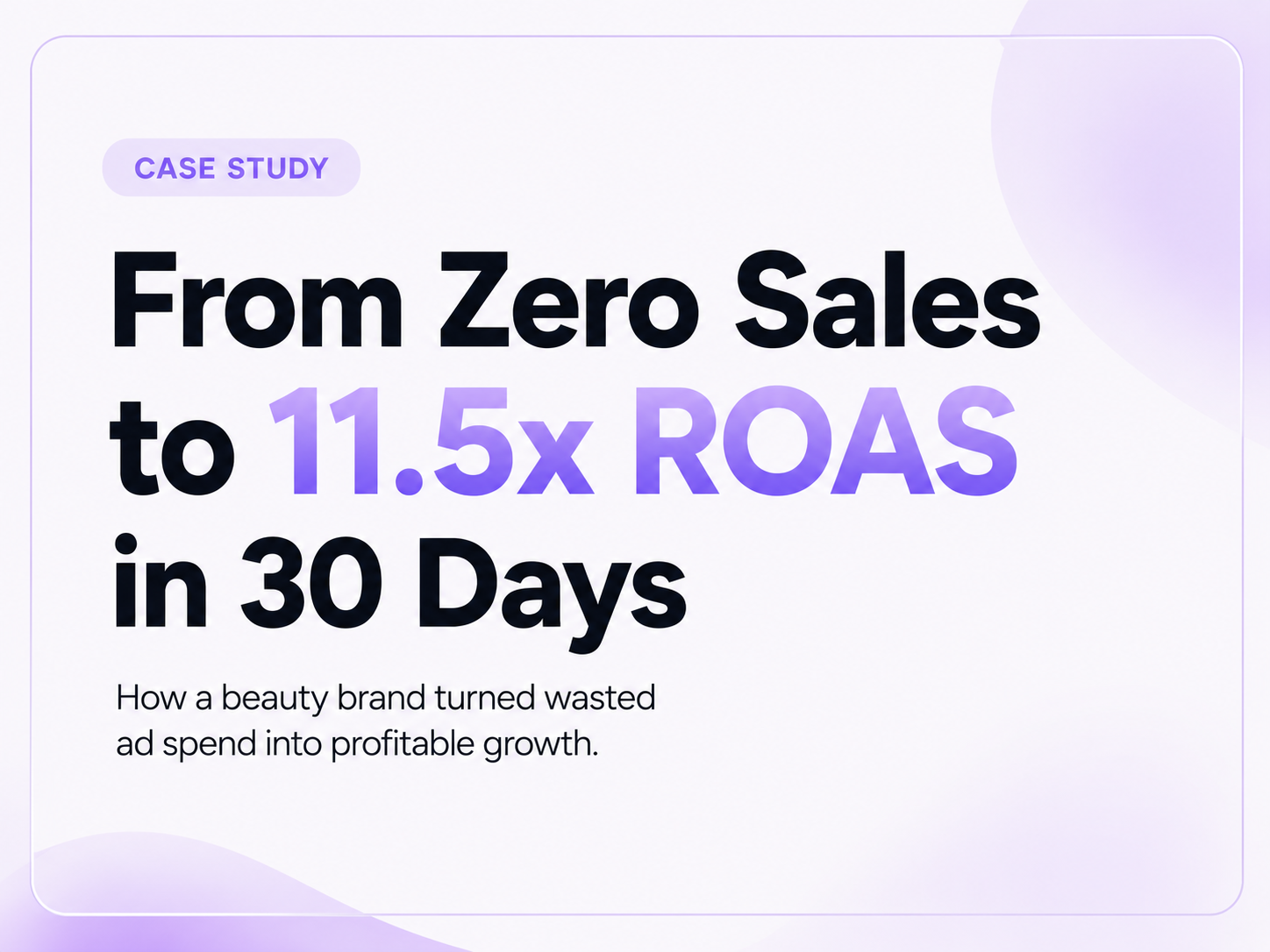
From Zero Sales to 11.5x ROAS: Scaling a Pakistani Beauty Brand with Performance Marketing
A Pakistani beauty and cosmetics brand selling skincare oils, creams, and other personal-care products approached me after experiencing disappointing marketing results. The owner had invested approximately PKR 800,000 into launching and building the business. Around PKR 200,000 had already been spent on marketing, but the brand had generated almost no sales from its advertising efforts. Despite having more than 7,000 Instagram followers, the business was struggling to convert its audience
The Challenge
Before working with me, the brand had hired someone to manage its marketing.
For approximately three months, most of the advertising budget was being spent on Instagram engagement campaigns. These campaigns helped the account receive likes, followers, and interactions, but they were not designed to generate purchases.
The business had:
- More than 7,000 Instagram followers
- Approximately PKR 200,000 spent on marketing
- Three months of engagement-focused advertising
- No proper sales campaign structure
- No clear customer acquisition strategy
- Almost no sales generated from paid advertising
The main problem was not simply the budget.
The problem was that the campaigns were optimized for engagement instead of purchases. Meta was finding people who were likely to like or interact with the posts, not people who were likely to buy beauty products.
The Initial Marketing Audit
Before launching any new campaigns, I conducted a complete audit of the brand’s advertising account, website, customer journey, and existing marketing activity.
The audit revealed several major issues.
Incorrect Campaign Objective
The brand had been running engagement campaigns for months.
Engagement campaigns can help increase likes, comments, and followers, but they are not the right choice when the primary business goal is online sales.
There were no properly structured sales campaigns focused on purchase conversions.
No Clear Sales Funnel
The brand did not have a clear journey that moved customers from discovering a product to trusting the brand and completing a purchase.
The ads, website, product pages, and messaging were not working together as one conversion-focused system.
Website Conversion Issues
The website was receiving visitors, but the user experience was not optimized for purchases.
Important product information, trust signals, calls to action, and conversion elements needed improvement.
Weak Campaign Structure
There was no structured approach for testing:
- Products
- Audiences
- Creative concepts
- Customer problems
- Offers
- Marketing messages
- Retargeting opportunities
Without structured testing, it was difficult to identify what could generate profitable sales.
The Strategy
After completing the audit, I developed a performance-marketing strategy focused on turning the brand’s existing traffic and audience into customers.
The strategy included:
- Replacing engagement-focused campaigns with sales campaigns
- Optimizing campaigns for purchase conversions
- Improving the website’s conversion rate
- Developing clearer product messaging
- Structuring campaigns for testing and scaling
- Identifying products with stronger sales potential
- Improving trust throughout the customer journey
- Retargeting people who had already shown interest
- Monitoring campaign performance based on revenue rather than likes
The goal was not to generate more vanity metrics.
The goal was to build a profitable customer-acquisition system.
Website Conversion Rate Optimization
Before increasing advertising spend, I improved the website to make it more conversion-focused.
The conversion rate optimization work included improving:
- Product-page structure
- Product benefits and descriptions
- Calls to action
- Website navigation
- Mobile shopping experience
- Trust-building elements
- Product presentation
- Checkout journey
- Messaging clarity
This was important because even a strong advertising campaign cannot perform well if the website fails to build trust or make purchasing easy.
The ads and website needed to support the same message and guide the customer toward one clear action: completing a purchase.
Meta Ads Restructuring
I rebuilt the Meta advertising strategy around sales and purchase conversions.
Instead of continuing to optimize for likes and engagement, the new campaigns were designed to find people who were more likely to purchase the brand’s beauty products.
The new campaign structure focused on:
- Sales campaign objectives
- Purchase conversion optimization
- Product-focused advertising
- New customer acquisition
- Retargeting warm audiences
- Creative and messaging tests
- Budget control
- Performance monitoring
- Scaling based on profitable results
Campaign decisions were made using important performance indicators such as:
- Return on ad spend
- Cost per purchase
- Click-through rate
- Cost per click
- Conversion rate
- Add-to-cart activity
- Checkout activity
- Purchase volume
Creative and Messaging Direction
The brand needed more than technical campaign changes.
It also needed advertising that clearly communicated why customers should consider its products.
The creative direction focused on:
- Customer problems
- Product benefits
- Product usage
- Beauty and skincare needs
- Trust and credibility
- Clear calls to action
- Conversion-focused messaging
Different products, messages, and customer angles were tested to identify what connected with the target audience.
This helped the campaign move away from generic engagement content and toward advertising designed to influence purchasing decisions.
The First 14 Days
Within the first 14 days of implementing the new strategy, the brand generated 21 orders.
This was an important improvement because the previous marketing activity had spent approximately PKR 200,000 without producing meaningful sales.
The early results confirmed that there was demand for the products. The business did not have a product problem, it had a campaign strategy and conversion problem.
By correcting the campaign objective, improving the website, and focusing on buyer intent, the brand started converting its traffic into customers.
Results After One Month
After one month of campaign management and optimization, the brand achieved a return on ad spend of 11.5x.
This means that for every PKR 1 spent on advertising, the campaigns generated approximately PKR 11.50 in tracked revenue.
Key Results- 21 orders generated within the first 14 days
- 11.5x ROAS achieved after one month
- Engagement campaigns replaced with sales-focused campaigns
- Website improved for stronger conversions
- A structured customer-acquisition strategy was introduced
- Campaign decisions shifted from likes and followers to revenue and purchases
- The brand moved from almost no advertising sales to a profitable campaign structure
Before and After Before Working With Me
- Approximately PKR 200,000 spent on marketing
- Nearly three months of engagement campaigns
- More than 7,000 Instagram followers
- Almost no sales from paid advertising
- No proper sales campaign
- No clear testing or scaling strategy
- Website not optimized for conversions
- Marketing performance judged mainly through engagement
- Sales campaigns optimized for purchases
- 21 orders generated within 14 days
- Website conversion experience improved
- Product and messaging tests introduced
- Retargeting and customer acquisition structured properly
- Campaigns optimized using revenue-based metrics
- 11.5x return on ad spend achieved after one month
Why the Strategy Worked
The improvement did not come from simply increasing the advertising budget.
It came from correcting the complete marketing system.
The brand already had products, website traffic, and an audience. However, the previous campaigns were asking Meta to find people who would engage rather than people who would purchase.
By aligning the campaign objective, website experience, product messaging, creative strategy, and customer journey, I turned the brand’s advertising into a performance-focused sales channel.
Conclusion
This project demonstrates the difference between social media activity and performance marketing.
Followers, likes, and engagement can support a brand, but they do not automatically generate revenue.
The business had already invested heavily in its products and marketing, but the advertising strategy was not connected to its sales objective.
After auditing the account, restructuring the campaigns, improving the website, and focusing on purchase conversions, the brand went from almost no paid advertising sales to 21 orders within 14 days and an 11.5x ROAS after one month.
The result was not just a better campaign. It was a more measurable, profitable, and scalable marketing system.
LET’S TALK
HAVE A QUESTION
OR FEEDBACK?
Ask me how this project was built, discuss a similar idea, or share your feedback about this case study.
YOUR OPINION